

Some days, I love social media. Other days, I’d be perfectly fine if it disappeared into oblivion.
On one hand, it allows us the privilege of getting to know brothers and sisters-in-Christ from all over the world, spur one another on, be able to share gospel hope with those we’d never cross paths with otherwise, and be able to stay up to date with friends and family.
On the other hand, it can become an unhealthy escape, a time-waster, a source of jealousy and comparison, an inducer of discontentment and insecurity, and a space that can tempt us to build our own little kingdom.
I could go on, but the point is that the same thing that can be a blessing to us can also be a thief of peace, joy, contentment, and true community.
So this begs the question – is it possible to embrace the blessings of it, while also guarding our hearts from comparing our lives to those on the other end of the screen?
Like most of life, there isn’t a black and white answer. And I certainly won’t pretend that I have it figured out. However, we need to be on guard to recognize the dangers lurking, not only behind our screens, but in our hearts. Because if we become aware of the temptations and pitfalls, we’ll be better able to recognize them, and reorient our hearts and habits when we do.
Although there are countless pitfalls to be aware of, I’d like to focus on one of the most prevalent among us all – comparison.
Comparison
Scrolling through our social media feeds, we inevitably stumble across a page that’s aesthetically pleasing, engaging, and fawned over by many. The offers tips on how to organize, lose ten pounds, bake the perfect loaf of sourdough, make crafts with your kids, dress for the occasion, homeschool your kids, journal through the bible, work a great job, and volunteer at church.
Even though we know in our head that a picture doesn’t tell the whole story, somehow, it still stirs a little part in our heart that wonders, “Why I am not like that?” “Why am I not better looking, more successful or creative, able to work and care for my kids with such perfect balance, or capable of that person’s capacity?” Even in the name of vulnerability, it’s often “curated vulnerability” that portrays a real picture but with filtered colors.
The problem is, the nature of social media will never accurately portray real life. Because, frankly, it’s not as nice to look at. Who wants the world to see their messy room, dirty bathroom, increasing wrinkles, failing business numbers frumpy, outfit, and arguing children? We’re far more likely to show our happy family picture than the meltdown that occurred two seconds later. Not that that’s wrong, it’s just the nature of the beast. Sure, we may be willing to share a mess our child made that others would find funny and relatable, but when it comes to revealing our own weaknesses, tension in our marriage, or the mold growing in the shower, that’s a hard pass.
So if the answer isn’t to start airing our dirty laundry, what is it?
It’s to go to battle with our hearts.
Because the truth is, comparison isn’t just a social media struggle, and it’s certainly not a new one. Ever since sin entered the world, comparison and its many relatives (jealousy, discontentment, envy, ingratitude, pride) have gained a foothold in the lives of men and women, even the most godly. In the Old Testament, Cain grew jealous of Abel when he saw God’s response to his brother’s sacrifice compared to his own (Genesis 4:4-5). Joseph’s brothers compared themselves to their favored brother (Genesis 37:5-8). Rachel envied her sister, Leah, for having multiple children while Rachel remained barren (Genesis 30:1). And the Apostle Paul challenged the Corinthians on this same sin. He wrote,
“Not that we dare to classify or compare ourselves with some of those who are commending themselves. But when they measure themselves by one another and compare themselves with one another, they are without understanding (2 Cor. 10:12).”
Paul challenged the Corinthians to not compare or judge themselves in light of others, which in this case, were false apostles who were creating standards they expected others to live up to, elevating themselves in the process. Instead, the Corinthians were to be more concerned with what God thought of them than those around them.
We, too, can fall into this trap if we aren’t careful. It can be tempting to present ourselves in the best possible light to build ourselves up – even if for just a moment. Or, we can scroll through social media and quickly find ourselves sinking deeper into self-loathing, insecurity, and jealousy as we begin to compare the inside of our lives to the outward snapshots of other’s. And as Paul wrote, we then become people “without understanding.”
But if we first bring our desire to be seen and known to the Lord, asking him to fill us with his truth and promises about our identity and worth in him, then we can enter social media without needing the approval of others to dictate our worth.
Examine Your Heart
Having social media is a modern blessing in many ways, allowing us to connect with others, learn from each other, spur each other on in God’s truth, and much more. And yet, while we are more connected than any other generation, we can also be lonelier than ever. In part, because social media has provided a false sense of true community.
So I encourage you with this – ask the Lord to search your heart and give you insight and awareness into your own temptations in this area (Psalm 139:23-24). Rather than running away from it because it draws our sin to the surface, we can learn to set healthy boundaries while going to battle with sin itself (which, yes, may mean stepping away for a time or indefinitely if the Lord leads).
Be in Community
We are what we fill ourselves with, so the greatest way to guard our hearts from falling into the trap of comparison is to first fill ourselves with what God says is true. And when we’re communing with God through his Word and prayer, social media is more likely to take its proper place.
However, in addition to spending time with the Lord, it’s important to invest in our local community where we’re able to enter the mess and beauty of each other’s lives in the deepest way. Social media can be similar to grabbing a handful of chips when we’re starving. It may be enjoyable and satisfying for the short-term, but we’ll quickly grow hungry for food that provides the nourishment our body needs. Similarly, social media can be a quick fix to our desire for connection because we can access “community” even if we’re alone. But just like grabbing a handful of chips won’t truly satisfy us, social media will never be able to provide the richness of doing life with those we’re face to face with. We can enjoy the positive aspects that online relationships offer, but need to remember to make in-person community (with the Lord and others) of highest priority.
Diagnostic Tools
Today, if you find yourself scrolling through social media and falling into the comparison trap, I encourage you to examine what you’re believing to be true.
Does this picture tell the whole story?
Does God see me as less than this person because I’m not as __________?
Has God gifted me differently than this person?
Am I jealous of his/her circumstances because I’m discontent with my own?
Do I base my value on how others see me?
Instead of comparing, can I pray for this person instead, knowing there’s always more to the story than I can see?
Friend, social media can be a blessing – but one we must enter into with guardrails, knowing the tendencies of our heart. May we use it in a way that glorifies Christ more than ourselves, encourages others more than we seek to be filled, and enables us to enjoy connecting with others rather than using it as a measuring stick of our value.
Home is around the corner,
Sarah
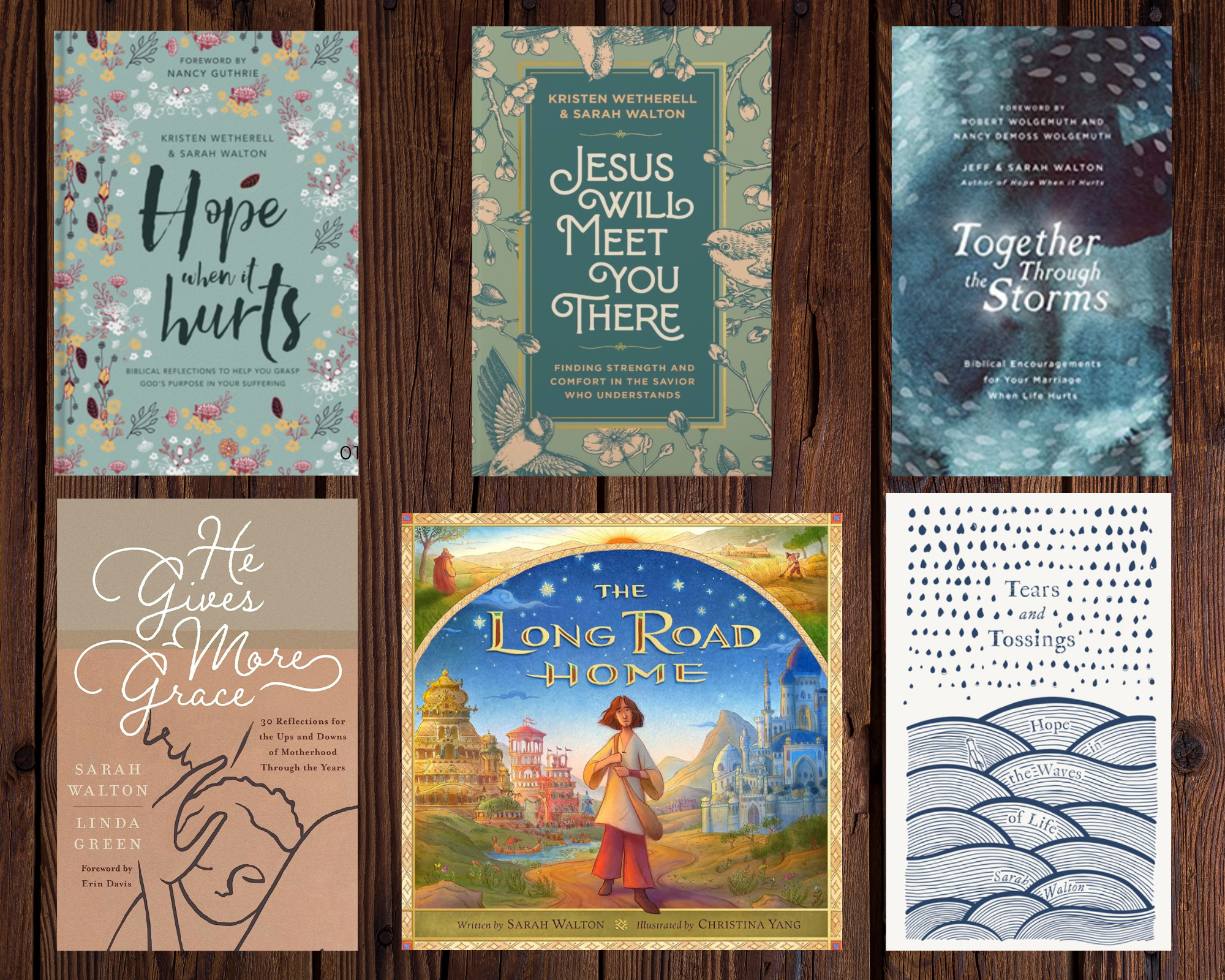
To read more of Sarah’s writings, you can pick up a copy of her new book, Jesus Will Meet You There: Finding Strength and Comfort in the Savior Who Understands. Her other books include, He Gives More Grace: 30 Reflections for the Ups and Downs of Motherhood, Hope When It Hurts: 30 Biblical Reflections to help you grasp God’s purpose in your suffering), Tears and Tossings (short evangelistic resource on how God carries our sorrows), or Together Through the Storms (for married couples navigating the trials of life). Lastly, a Pilgrim’s Progress inspired children’s book based on the account of the Prodigal Son, titled “The Long Road Home” (Crossway).