“Maybe tomorrow will be better,” I’ve thought countless times before.
And yet, here I am, still waiting for that “better tomorrow” to arrive.
During my younger teen years, random health struggles began to arise. As a young mom in my early twenties, symptoms intensified tenfold. Since then, the days have turned to months; the months have turned to years; the years have turned to decades.
Over time, illness has ravaged the frame I dwell within, and even as I fight with every tool that’s been availed to me to restore a degree of health, aspects of this temporary body are likely beyond repair in this world. In the Lord’s incredible kindness, he has provided the resources to go through an extensive medical plan to treat infections and underlying issues that have brought me to this sad state of affairs, and I will be forever grateful for the opportunity to regain as much health as the Lord allows on this side of heaven. And yet, ironically, the more I treat the illnesses, the more profoundly aware of how sick I’ve been. The wretched effects of sin in this world can truly wreak havoc on every divinely designed cell within us. Therefore, apart from a miracle or the Lord bringing me to home to be with him, to one degree or another, I am bound to live within this painfully fractured frame. I, like many others, must live in the constant tension of remaining hopeful for increased healing and acceptance of what may never be in my lifetime.
If you can relate, you understand that, to endure, you must find a way to keep living within the bounds of pain and limitations with some degree of normalcy. If you don’t, you’ll shrivel up and waste away—in spirit, if nothing else. When pain (and the losses that come with it) is a daily presence, we always have a choice: give way to the despair that’s beckoning us to let it in for just a little while, or keep pressing forward one weary step at a time, even if we must limp our way onward.
I admit, however, that there are days when despair and earthly hopelessness find their way in through the side window. Sometimes, they even pull up a seat at the kitchen table with a cupcake and a candle, drawing me in with their melancholy song of self-pity.
Every day is a fight for faith when pain and the sorrows of this world have forever changed you. Because they don’t just impact your hopes, dreams, and expectations of life, they change every part of who you once were.
In our humanity, those changes can feel like the death of us—as the joyful sounds of the life we expected gradually fade into the distance. We are no longer who we once were. We no longer walk with a light-hearted bounce in our step that came with the joys of youthful ignorance. Hell has splashed over, and we are forever changed by it.
Death to Self, Life to Christ
That’s why Ecclesiastes is one of my favorite books of the Bible. It’s like a somber song played in a minor key, sung by one whose eyes have been unveiled to the sobering complexities of this seemingly futile world. And yet, it’s a strangely beautiful sound to those of us whose eyes have been similarly opened, wrestling with the dichotomies of hopelessness and hope, grief and joy, loss and gain, brokenness and redemption, death and life.
“For with much wisdom is much sorrow; as knowledge increases, grief increases” (Ecclesiastes 1:18).
The more we experience in this life—pain, loss, unanswered questions, endurance in suffering, a taste of death, etc.—the more we’re awakened from our ignorant stupor and forced to acknowledge our limited understanding in a world full of mystery.
This is why those who have experienced very little often have a lot to say, while those who have experienced much are often quieted by the mysteries and complexities of life.
True wisdom comes from being knocked off our pedestals of pride to see things as God sees them. And that rarely happens apart from suffering that shakes our man-made, self-righteous foundation until it’s a heaping pile of rubble. Without a doubt, humility is painfully gained but profoundly life changing.
Therefore, as much as I long to be free from the pain of a body groaning to be made whole and the struggles of living in a world full of sorrow, I am truly grateful how they have awakened me from my earthly stupor. The very brokenness I long to be free from has also been what God has used to increasingly free me from my independent, self-confident, frantically wandering self. The limits I despise have brought me into the limitless presence of God’s strength and comfort like nothing else has. The sense of control I have lost has taught me to rest in the promises of the One who is in control. The countless moments I’ve cried for relief have been what’s led me to experience his strength and comfort to endure. And more than anything, the losses I grieve in this world have only increased my longing for the soul-satisfying life to come.
Pain, and the many losses it has brought, has been the death of who I once was. But it has also been the soil where the seeds of gospel hope life in Christ have been toiled, watered, and grown into the sweet tasting fruit that Matthew assured us of:
“Blessed are the poor in spirit,
for theirs is the kingdom of heaven.
Blessed are those who mourn,
for they will be comforted.
Blessed are the meek,
for they will inherit the earth.
Blessed are those who hunger and thirst for righteousness,
for they will be filled.
Blessed are the merciful,
for they will be shown mercy.
Blessed are the pure in heart,
for they will see God.
Blessed are the peacemakers,
for they will be called children of God.
Blessed are those who are persecuted because of righteousness,
for theirs is the kingdom of heaven” (Matt. 5:3-10).
A Broken Instrument Can Still Make Beautiful Music
Even still, in my humanity, the weariness of the day to day can still leave me feeling overwhelmed by the brokenness of it all. And many days, I’m acutely aware of the dark tones of grief that reverberate at the most unexpected moments. Life is still hard, and the why’s behind much of it remain a mystery.
Therefore, maybe those dark, somber tones are not to be dismissed in our lives as though they are getting in the way of something more beautiful. If fact, maybe they are an integral part of a new song of that God is bringing forth from and through our broken lives—
“to grant to those who mourn in Zion—
to give them a beautiful headdress instead of ashes,
the oil of gladness instead of mourning,
the garment of praise instead of a faint spirit;
that they may be called oaks of righteousness,
the planting of the Lord, that he may be glorified.” Is. 61:3
Joni Eareckson Tada shared a beautiful picture of this concept in her book, “A Place of Healing”. In it, she shares a story that a columnist wrote years ago about a violinist named Itzhak Perlman, who had polio as a child, requiring him to walk with crutches and braces on both legs.
At the symphony, he wouldn’t begin at his seat, he would walk across the stage slowly until he reached his seat, laid down his crutches, removed his leg braces, and picked up his violin.
She goes on to say that in the middle of a concert in New York, one of the strings on his violin snapped mid-performance. The other musicians stopped at the sound of the string breaking and the crowd stared in silence, “unsure of what he was going to do with only three strings, knowing it was impossible to play a symphonic song with only three strings.”
Apparently, after closing his eyes for moment, Mr. Perlman signaled to the conductor to proceed, and continued playing, “recomposing the piece in his head as he went along, inventing new fingering positions to coax never-before-heard sounds from his three-string violin.”
When the piece was over, he received a standing ovation. “Mr. Perlman apparently smiled, wiped the sweat from his brow, and said in a soft, reverent tone, ‘You know, sometimes it is the artist’s task to find out how much music you can still make with what you have left.’”
Using this powerful analogy, Joni goes on to say “that whatever strings are broken in our lives—if we concentrate, if we apply what we know—we can still play beautiful music with what we have left. In fact, it will be music that no one else can play in the same way. Sometimes we have to take what’s left and coax out of life something new and different. Life becomes recomposition, a series of new chords.”
Those of us who long suffer through disabilities, injuries, illness, and chronic pain “aren’t regular violins, and God doesn’t perform in our lives in ordinary ways. God is the one who finds incomparable beauty and makes matchless music using the most unexpected and unlikely of instruments. His melody—His incomparable, heavenly, impossibly beautiful music—somehow comes into its own when it emanates from a broken, battered, but fully yielded human vessel.”1
You and I may feel like a broken instrument today, but in the hands of our great God, he can bring the most beautiful, unlikely music from our life in ways he never would have if we had remained whole and unbroken.
We may not know how to bring anything beautiful from our broken lives right now, but that’s not our job. Our job is simply to entrust ourselves into the hands of the One who can bring forth a glorious new song from what remains.
And when he does, I believe the heavenly hosts will roar with applause and a standing ovation—not praising us, the broken instrument, but the master Artist whose divine hands created a masterpiece through the least likely instrument.
Home is around the corner,
Sarah
1 Tada, Joni. Eareckson. A Place of Healing. Pg. 119-121
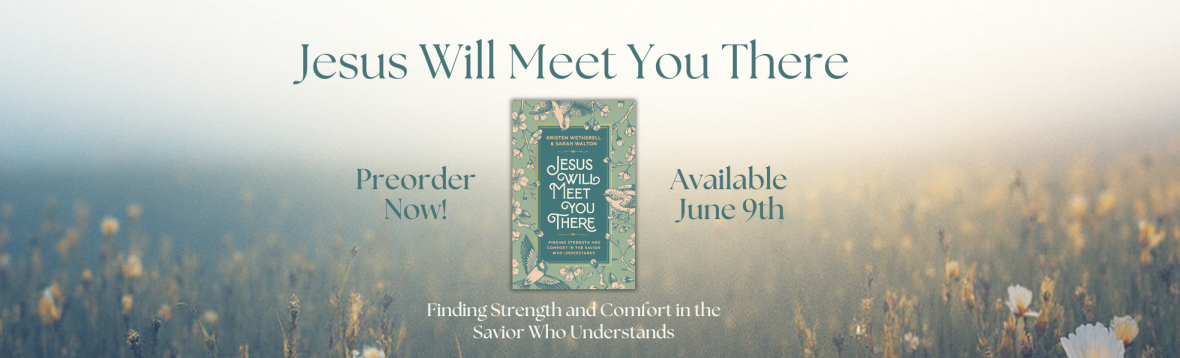
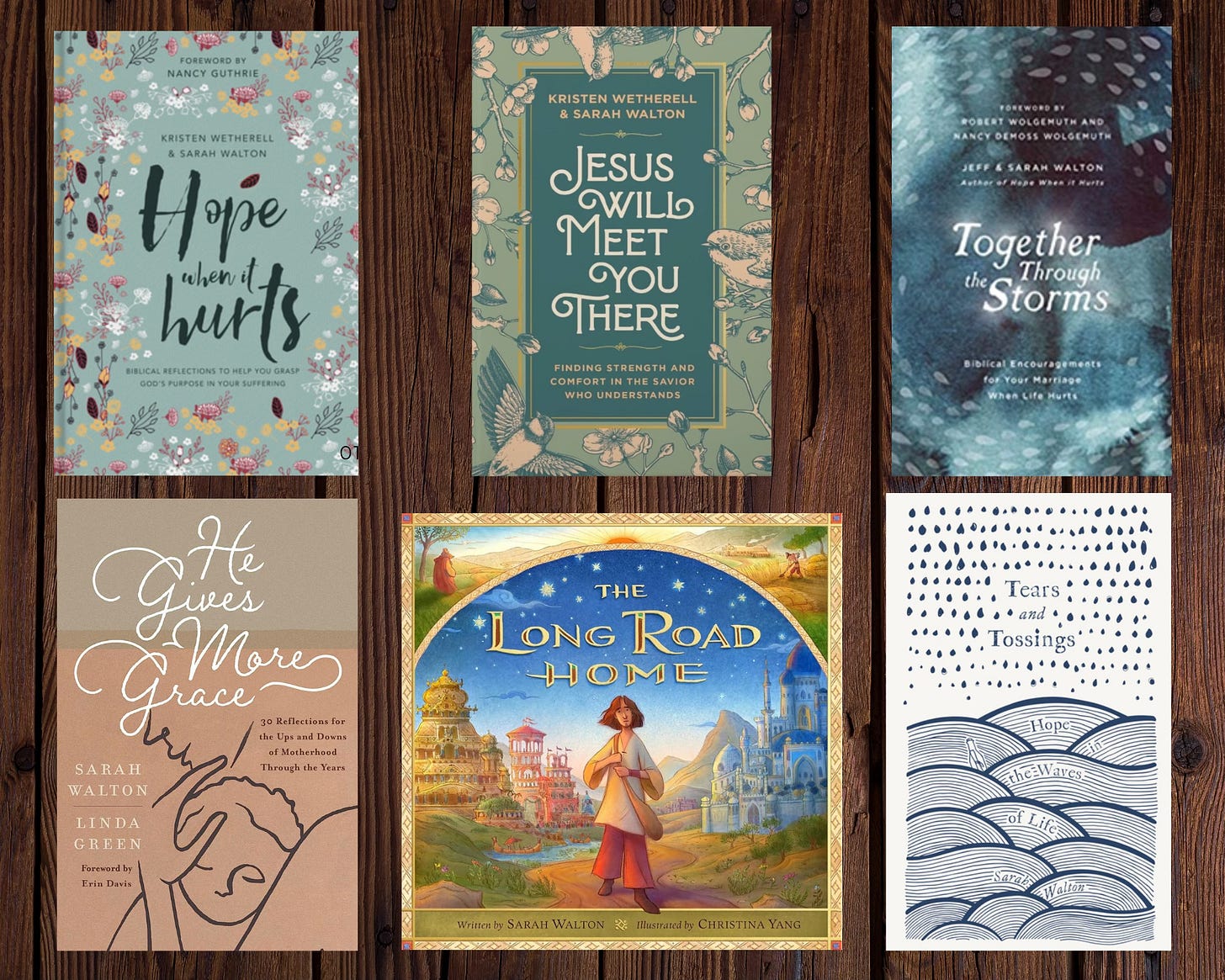
To read more of Sarah’s writings, you can pick up a copy of her new book, Jesus Will Meet You There: Finding Strength and Comfort in the Savior Who Understands. Her other books include, He Gives More Grace: 30 Reflections for the Ups and Downs of Motherhood, Hope When It Hurts: 30 Biblical Reflections to help you grasp God’s purpose in your suffering), Tears and Tossings (short evangelistic resource on how God carries our sorrows), or Together Through the Storms (for married couples navigating the trials of life). Lastly, a Pilgrim’s Progress inspired children’s book based on the account of the Prodigal Son, titled “The Long Road Home” (Crossway).


Beautiful. And so true. ❤️ Evy
I’m not sure if this is a typo or if you wanted it to be this way…
Perlman signaled to the conductor to proceed, and continued playing, “recomposing the piece in his head as he went along, inventing new fingering positions to coax never-before-heard sounds from his three-********”strong ******violin.”
pardon smartphone brevity/typos 🙂
LikeLiked by 1 person
Ah yes, thank you! It’s definitely supposed to say three-string violin! Thanks for catching that!
LikeLike
Thank you for the hope you have given me through your post. What an amazing reminder. Thank you!
LikeLiked by 2 people